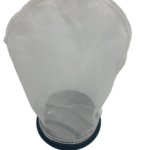
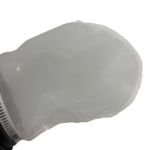
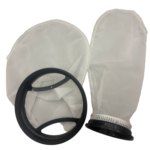
Nylon filter bag:
The nylon filter bag — often listed as an NMO filter bag (nylon monofilament mesh) — is made from a woven monofilament mesh with a precisely controlled pore structure.
Unlike felt media that trap particles throughout the depth of the fabric, nylon mesh holds particles on its surface, which makes it fully washable and reusable. Ratings from 1 to 400 micron are available.
Nylon Filter Bag Micron Ratings:
Nylon mesh filter bags are available in ratings from 1 micron up to 400 micron. A 100 micron nylon filter bag is the most common choice for general liquid clarification, while 5–25 micron ratings suit polishing and pre-coat applications, and 200 micron bags handle coarse particle removal and pump protection.
Because the mesh is woven, the rating refers to the actual opening size — there is no nominal/absolute ambiguity you get with felt
Washable, Reusable Filter Bags:
Because filtration happens on the surface, a used nylon filter bag can be backflushed or rinsed and put back into service — often dozens of cycles.
For high-volume processes this makes washable filter bags dramatically cheaper per litre filtered than disposable felt bags, and they are the standard choice wherever housings can be opened for cleaning on a regular schedule.
Applications:
Typical applications include nylon filter bags for paint and coatings circulation, coolant filtration on machining lines, pre-filtration ahead of membrane and cartridge systems, food and beverage filtration such as syrup and edible oil, and general water treatment.
The smooth mesh surface also performs well on viscous, stringy products that blind felt media quickly.
Temperature & Chemical Compatibility:
Nylon handles working temperatures up to about 140°C in dry service, but it absorbs moisture and will hydrolyse in continuous hot water or steam, so for wet heat above 80°C consider polyester or PP instead.
Chemical compatibility is strong on alkalis, oils and many solvents — where nylon outperforms most synthetics — but strong mineral acids will attack the fibre; for acid service choose PP or PTFE.